

Today, there are two different options available in the market for 3D Mapping, Lidar Laser and Photogrammetry. The parameters and use conditions differ with different products. A couple of years ago, the introduction of laser sensing and computation anticipated a change in the technology. At that time, these two new technologies caused rapid development with […]

Imagine driving to a remote tourist destination last Christmas—somewhere completely unfamiliar, yet you arrived safely and confidently. How was this possible? The most likely answer is that you relied on Google Maps, enhanced by the advanced LiDAR laser technology integrated into your car. Modern vehicles often feature a 3D color map of the immediate surroundings […]

LiDAR lasers are among the most useful tools for remote sensing since they can accurately map environments in high resolution regardless of the weather. A variety of novel applications that were previously impractical or expensive are now possible when these sensors are integrated with drones. These examples illustrate just a few of the many applications […]
Throughout recent times, the only effective sources for spectroscopy were discharge lamps, dye lasers, and optical parametric oscillators. Supercontinuum lasers, sensor plasma sources, and light-emitting diodes are a few examples of new broadband light sources that are now accessible. This article examines the potential of these choices for spectroscopic applications. Since spectroscopic systems depend on […]
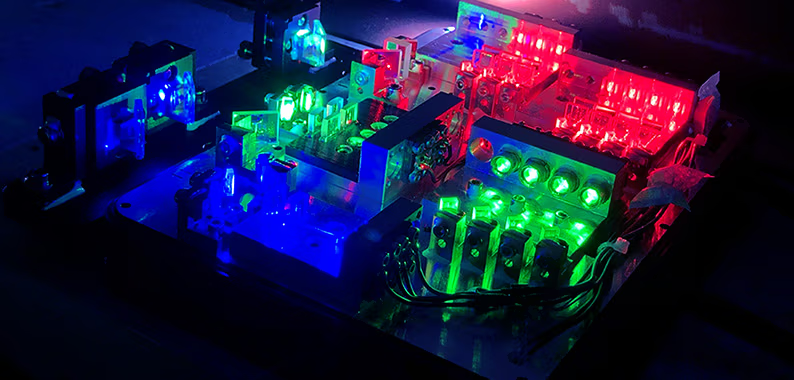
The SLED’s peak wavelength and intensity are influenced by the active material’s composition as well as the degree of injection current. SLEDs, unlike laser diodes, are made to have strong single pass amplification for spontaneous emission produced along the waveguide but inadequate feedback to produce lasing activity. One sort of technology that can fill the […]

Different kinds of lasers have been developed in recent years to meet the growing need for telecommunication. The DFB laser is one such example. Using distributed feedback lasers is one of the greatest approaches to addressing the demands of low-signal lasers. Such lasers not only satisfy the demands of the telecommunications sector but also have […]
A broadband light source (BLS), as opposed to the monochromatic light source, generates light throughout a wide range of wavelengths. These light sources rely on the increased spontaneous emission of diode-pumped erbium-doped fibers. Broadband light sources are particularly useful since they emit a wide variety of light wavelengths. The tungsten-halogen lamp, which is normally driven […]
A superluminescent diode is a high-power LED built around a PN junction embedded in an optical waveguide. When electrically biased in the forward direction, it exhibits optical gain and generates amplified spontaneous emission over a wide range of wavelengths. An SLD light source has an output power similar to a laser diode, the wide oscillation […]

The new lasers open the way for the integration of optical and electrical components on gain chips, a breakthrough that might enhance computing speeds and data transmission rates considerably. Optical communications, spectroscopic methods, and frequency metrology have all been made possible by tunable lasers with small spectral line widths. Gain chips are semiconductor optical devices […]
The Distributed Feedback Laser, also known as the DFB laser, is a type of laser widely used for high-capacity long-distance transmission. Fiber-optic sensing, laser radar, fiber optical communication, barcode readers, disc reading, and laser scanning are just a few of the major applications of distributed feedback lasers. The key characteristics that have made DFB lasers […]