
In the transformative landscape of 2026, the digital world is witnessing a paradigm shift that rivals the invention of the internet itself. We have transitioned from the era of “Cloud Computing” to the era of “Ubiquitous Intelligence.” Generative AI (Gen AI) is no longer confined to massive, localized data centers; it is bleeding out into the network edge—into our cars, our factories, 5G towers, and city streets. However, this migration faces a formidable adversary: physics. Specifically, the latency inherent in transmitting data over vast distances. As we stand on the precipice of the premier industry gathering, OFC 2026, the solution to this latency crisis is becoming clear. It requires a marriage of high-speed Optical Fiber Communication and a critical, often understated component: the Semiconductor Optical Amplifier.
Part 1: The Latency Bottleneck in the Age of Inference
To understand the sudden strategic importance of the Semiconductor Optical Amplifier, one must first understand the changing nature of AI workloads. In 2023 and 2024, the focus was on training—building massive Large Language Models (LLMs) like GPT-4. This happened in centralized hyperscale data centers where thousands of GPUs were clustered together.
By 2026, the focus has shifted to inference—the actual use of these models by billions of devices. When a self-driving car detects a pedestrian, or an automated robotic arm in a factory spots a defect, it cannot afford to send video data 500 miles to a central server and wait for a response. The “inference” must happen locally, or at the “Edge.”
However, Edge infrastructure is space-constrained. You cannot fit a hyperscale data center inside a roadside cabinet. This physical limitation creates a signal integrity problem. Optical fiber is the only medium capable of carrying the massive bandwidth Gen AI requires (often exceeding 1 Terabit per second), but optical signals degrade as they are split and routed through complex edge networks. In traditional telecom, we used Erbium-Doped Fiber Amplifiers (EDFAs) to boost these signals. But EDFAs are bulky, expensive, and power-hungry. They simply do not fit in the compact architecture of Edge AI.
This gap has catapulted the Semiconductor Optical Amplifier into the spotlight. It is the only device capable of providing the necessary signal gain within the microscopic footprint required by modern AI hardware.
Part 2: Deconstructing the Semiconductor Optical Amplifier
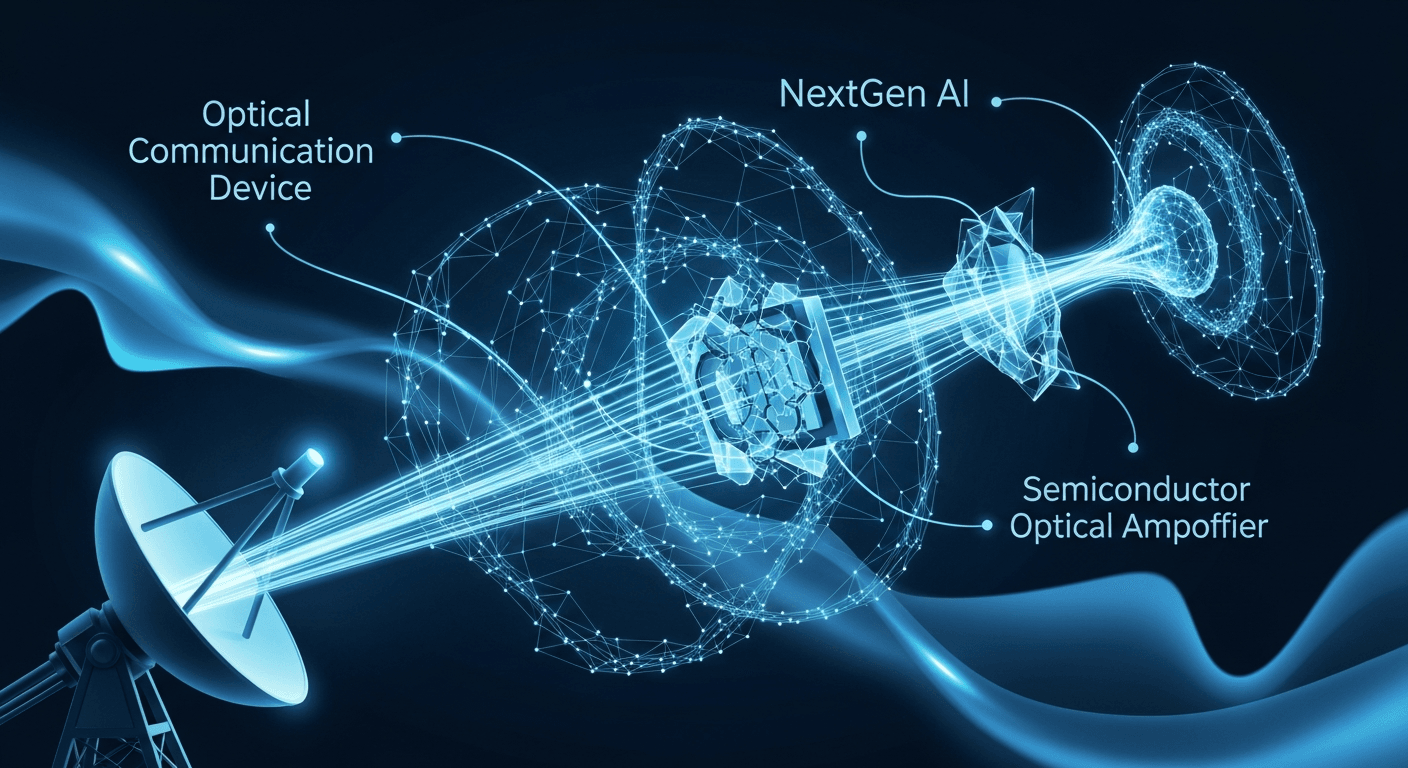
A Semiconductor Optical Amplifier is, in essence, a laser without mirrors. It is a chip-based device that uses a semiconductor gain medium—typically Indium Phosphide (InP)—to provide light amplification through the process of stimulated emission. When light enters the device, it stimulates the emission of photons, boosting the signal’s intensity while maintaining its data content. In many ways, it operates similarly to a laser diode, but without the resonant cavity and mirrors, thereby offering a more compact and application-specific solution.
Unlike fiber-based amplifiers that look like spools of cable, a Semiconductor Optical Amplifier is microscopic. It can be manufactured on wafers, similar to computer chips, making it mass-producible and cost-effective. For decades, it was considered a niche technology, plagued by high noise figures and nonlinearities. However, the requirements of Gen AI have turned these “bugs” into features, or at least rendered them manageable, driving a massive resurgence in interest leading up to OFC 2026.
The compact nature of the Semiconductor Optical Amplifier allows it to be deployed in places where optical amplification was previously impossible: inside transceiver modules, on server motherboards, and even co-packaged directly with the AI processor itself.
Part 3: OFC 2026 and the New Standards of Connectivity
The upcoming Optical Fiber Communication Conference and Exposition, or OFC 2026, is poised to be the most significant event in the industry’s recent history. While previous years focused on raw speed (400G, 800G), OFC 2026 is expected to focus on “Architecture for AI.”
Analysts predict that OFC 2026 will be the launchpad for new MSA (Multi-Source Agreement) standards regarding optical interconnects for distributed AI clusters. A central pillar of these discussions will be the integration of the Semiconductor Optical Amplifier into standardized pluggable modules.
The industry buzz surrounding OFC 2026 suggests that major hyperscalers (Google, Microsoft, Amazon) are seeking solutions to “break the glass ceiling” of power consumption. They need optical components that use less than 5 picojoules per bit. The Semiconductor Optical Amplifier is a primary candidate to achieve this, as it eliminates the need for power-hungry digital signal processing (DSP) in certain short-reach applications, a concept known as Linear Drive Optics (LPO).
Part 4: The Technical Synergy: Fiber, AI, and SOA
The relationship between Optical Fiber Communication and the Semiconductor Optical Amplifier is symbiotic. Fiber provides the highway; the amplifier provides the fuel. In the context of Gen AI, this relationship is evolving in three specific ways:
1. The Shift to the O-Band (131nm)
Standard long-distance fiber networks operate in the C-Band (155nm). However, for short-distance AI connections (10 meters to 2 kilometers), the O-Band (131nm) is preferred because it suffers from less chromatic dispersion, meaning the signal stays “sharp” without complex correction.
EDFAs are notoriously difficult to engineer for the O-Band. In contrast, the Semiconductor Optical Amplifier naturally excels at these wavelengths. The bandgap of Indium Phosphide can be easily tuned to provide peak gain at 131nm. This makes the Semiconductor Optical Amplifier the de facto standard for the O-Band interconnects that form the nervous system of AI clusters. We expect O-Band amplification to be a major theme in the technical sessions at OFC 2026.
2. Integration and Silicon Photonics
One of the most pressing challenges in Gen AI hardware is “I/O limitations.” GPUs are becoming so fast that they cannot get data in and out quickly enough. Silicon Photonics (using light to move data on chips) is the solution.
However, Silicon Photonics suffers from high coupling losses. Getting light from a fiber strand into a silicon chip results in signal loss. To fix this, engineers are integrating a Semiconductor Optical Amplifier directly onto the silicon photonic circuit. Often, these amplifiers incorporate tapered waveguide designs—where the structure is gradually widened—to improve coupling efficiency and reduce losses. Such tapered structures not only enhance performance but also enable a tighter integration with the circuit. This “Heterogeneous Integration” places the amplifier right where the loss occurs. This capability is unique to the Semiconductor Optical Amplifier; you cannot simply glue a fiber amplifier onto a silicon chip.
3. Burst Mode Operation
AI traffic is “bursty.” Unlike a phone call, which is a steady stream, AI inference requests come in massive, sudden spikes. A Semiconductor Optical Amplifier has nanosecond-level reaction times. It can turn on, amplify a burst of data, and turn off (or adjust) almost instantly. This rapid response prevents data collisions and ensures latency remains low, a critical requirement for real-time Gen AI applications.
Part 5: The Green AI Revolution
Sustainability is a massive SEO trend and a genuine industry concern. Training a single AI model can emit as much carbon as five cars in their lifetimes. The infrastructure supporting AI must become more efficient.
The Semiconductor Optical Amplifier plays a vital role in “Green Networking.” Because it is a direct-current device, it is generally more power-efficient for short-reach applications than pump-laser-driven fiber amplifiers. Furthermore, by enabling “All-Optical” switching (routing data using light instead of converting it to electricity and back), the Semiconductor Optical Amplifier helps remove energy-wasting conversion steps from the network.
At OFC 2026, “Green Photonics” will be a headline track. We anticipate several papers demonstrating how replacing electrical switches with Semiconductor Optical Amplifier based optical gates can reduce the total power consumption of an Edge AI data center by up to 30%.
Part 6: Market Trends and Future Projections
The market for optical components is exploding, driven by the AI gold rush. Financial analysts covering the sector project that the market for the Semiconductor Optical Amplifier will outpace the general optical components market over the next five years.
The “Scale-Out” Architecture
AI supercomputers are built using a “scale-out” architecture, meaning they grow by adding more nodes rather than making existing nodes larger. This requires millions of optical interconnects. If every interconnect requires amplification to overcome loss, the volume demand for the Semiconductor Optical Amplifier becomes astronomical.
1.6 Terabit Ethernet
The industry is currently transitioning from 800G to 1.6T Ethernet. At these speeds, the signal becomes incredibly fragile. Attenuation that was negligible at 100G is catastrophic at 1.6T. The Semiconductor Optical Amplifier is increasingly being used as a pre-amplifier in the receiver (Rx) optical sub-assembly (ROSA) to boost the signal before it hits the photodetector. This ensures that the high-speed data stream remains readable.
Cost Reduction Curves
As manufacturing volumes increase, the cost of the Semiconductor Optical Amplifier is dropping. This follows the “Moore’s Law” of photonics. By OFC 2026, we expect to see pricing models that make SOAs viable not just for high-end data centers, but for consumer-grade connections, potentially bringing fiber-optic speeds to home AI appliances.
Part 7: Challenges to Overcome
Despite its promise, the Semiconductor Optical Amplifier is not a magic wand. It faces technical hurdles that occupy the minds of the world’s best engineers.
Noise Figure: A Semiconductor Optical Amplifier adds more noise to a signal than an EDFA. For analog signals, this is a problem. However, digital AI signals are robust. Advanced Forward Error Correction (FEC) algorithms allow AI systems to tolerate the slightly higher noise floor of a Semiconductor Optical Amplifier.
Polarization Sensitivity: Light traveling through fiber changes its polarization. A standard Semiconductor Optical Amplifier amplifies light differently depending on this polarization, which is bad for data integrity. Manufacturers have developed “Polarization Independent” SOAs using strained quantum wells to mitigate this. This technology has matured significantly and will be a key showcase at OFC 2026.
Nonlinearities: If the input power is too high, a Semiconductor Optical Amplifier can distort the signal. However, in an ironic twist, researchers are now using these nonlinearities to perform computations. By manipulating the saturation of the Semiconductor Optical Amplifier, it can act as an optical logic gate, performing simple AI processing tasks at the speed of light.
Part 8: The Road to OFC 2026 and Beyond
As we prepare for OFC 2026, the narrative is clear. The event will likely be remembered as the moment when the optical industry fully pivoted to serve the needs of Artificial Intelligence. The floor plan at OFC 2026 will be dominated by solutions addressing the “AI Interconnect Bottleneck.”
We expect to see:
- Arrays of SOAs: Single chips containing 4, 8, or even 16 Semiconductor Optical Amplifier channels to support parallel fiber ribbons.
- Co-Packaged Optics Demos: Live demonstrations of GPUs with integrated fiber ports powered by on-chip amplification.
- New Materials: Research into Quantum Dot SOAs that offer higher gain and better temperature stability.
The Semiconductor Optical Amplifier has graduated from a component of convenience to a component of necessity. It is the enabler that allows the theoretical speeds of optical fiber to be realized in the messy, constrained, and hot environment of the real-world Edge.
Part 9: Practical Applications in Edge AI
To visualize the impact, consider a smart factory in 2026. Thousands of sensors monitor equipment health using Gen AI to predict failures. The factory floor is electrically noisy, making copper wiring unreliable. Optical fiber is immune to this noise.
However, the fiber must be routed through tight corners and split to hundreds of machines. Each split weakens the signal. A traditional amplifier is too large to mount on a robotic arm. Instead, a compact Semiconductor Optical Amplifier is integrated into the sensor’s transceiver. It boosts the signal immediately, ensuring that the critical data reaches the central AI controller without latency or loss. This is the reality of the Semiconductor Optical Amplifier in action.
Similarly, in 5G and 6G telecommunications, “Remote Radio Heads” are being pushed further out to the edge. These units require optical backhaul. The Semiconductor Optical Amplifier provides the necessary reach extension in a package that fits within the thermal and physical envelope of the antenna housing.
Part 10: InPhenix – Leading the Optical Revolution
In the complex ecosystem of optical components, the quality of the hardware dictates the reliability of the network. This is where InPhenix distinguishes itself. As a world-class manufacturer of lasers and light sources, InPhenix has consistently been at the vanguard of Optical Fiber Communication innovation. Their specific focus on high-performance InP technology has resulted in a Semiconductor Optical Amplifier product line that offers industry-leading gain, bandwidth, and reliability.
InPhenix understands that in the era of Gen AI, “good enough” is no longer acceptable. Their devices are engineered to withstand the rigorous demands of hyperscale and Edge environments, providing the stable amplification necessary for trillion-parameter model inference. As the industry converges for OFC 2026, InPhenix is set to demonstrate why they remain a preferred partner for top-tier network equipment manufacturers. By combining cutting-edge fabrication techniques with deep optical expertise, InPhenix is not just attending OFC 2026; they are helping to define the very future of optical connectivity, ensuring that the Semiconductor Optical Amplifier remains the beating heart of the AI-driven world.
Extended Analysis: The Physics of Gain in 2026
To truly appreciate the utility of the Semiconductor Optical Amplifier in 2026, we must dive deeper into the physics of “Gain Saturation” and “Recovery Time,” two metrics that will be hotly debated in technical sessions at OFC 2026.
In a standard fiber amplifier (EDFA), the excited ions have a long lifetime (milliseconds). This makes the amplifier slow to react. In a Semiconductor Optical Amplifier, the carrier lifetime is in the order of picoseconds to nanoseconds. This fast physics is what allows the device to handle the erratic, packet-based traffic of the Internet and AI clusters. Moreover, the fundamental process of stimulated emission not only ensures rapid recovery but also guarantees consistent light amplification even when handling rapid bursts of data.
However, this speed comes with a trade-off: Cross-Gain Modulation (XGM). If multiple wavelengths (colors of light) are passing through a Semiconductor Optical Amplifier simultaneously, a strong pulse on one color can deplete the carriers, causing the gain to drop for the other colors. This is “crosstalk.”
For years, XGM was the enemy. But leading into OFC 2026, new designs are mitigating this. By using “Gain Clamping” techniques—essentially using an internal laser oscillation to keep the carrier density constant—modern Semiconductor Optical Amplifier designs can support Wavelength Division Multiplexing (WDM) with minimal crosstalk. This breakthrough is essential for “scaling up” bandwidth without adding more fibers.
The Role of Linear Pluggable Optics (LPO)
One of the most disruptive trends overlapping with the rise of the Semiconductor Optical Amplifier is Linear Pluggable Optics (LPO). Traditional optical modules use a Digital Signal Processor (DSP) chip to clean up the signal. DSPs are great, but they consume power and add latency (about 100-200 nanoseconds).
In the world of AI training, where thousands of GPUs work in parallel, that latency adds up. LPO removes the DSP. It relies on the linear drive capability of the electronics and the optics. However, without a DSP to digitally boost the signal, the optical components must be higher quality and provide higher power.
This is a perfect use case for the Semiconductor Optical Amplifier. By integrating a high-linearity Semiconductor Optical Amplifier into the LPO module, engineers can provide the necessary analog gain to drive the signal over the fiber, achieving the low power and low latency of LPO without sacrificing reach. We anticipate that LPO solutions featuring the Semiconductor Optical Amplifier will be among the most photographed demos at OFC 2026.
Manufacturing Supremacy and Supply Chain
The strategic value of the Semiconductor Optical Amplifier also lies in its supply chain. Unlike EDFAs, which rely on rare-earth elements (Erbium), the Semiconductor Optical Amplifier is based on Indium and Phosphorus. While these are critical materials, the fabrication process aligns with standard semiconductor foundry processes.
This scalability is crucial. As Gen AI deployments reach into the millions of units, the industry cannot rely on components that require manual assembly or winding of fiber spools. The Semiconductor Optical Amplifier is a “printed” device. A single wafer can yield thousands of chips. This manufacturing efficiency is what will allow optical fiber to replace copper in the “last meter” connectivity inside server racks—a transition predicted to accelerate rapidly after OFC 2026.
Conclusion: The Invisible Engine
As we move through 2026, the Semiconductor Optical Amplifier remains largely invisible to the average user. They see the capabilities of the AI—the instant translation, the autonomous navigation, the creative generation. But none of this is possible without the physical infrastructure moving the bits.
The latency that kills AI is being conquered not just by code, but by light. The Semiconductor Optical Amplifier creates the optical power budget necessary to fling that light across the complex web of the Edge. It is the bridge between the microscopic world of the GPU and the macroscopic world of the fiber network.
The discussions, papers, and product launches at OFC 2026 will solidify this reality. The event will showcase that while the fiber is the road, and the AI is the cargo, the Semiconductor Optical Amplifier is the engine that keeps the traffic moving. For investors, engineers, and tech leaders, keeping an eye on the development of this tiny chip is essential for understanding the big picture of the future.
InPhenix, with its steadfast commitment to quality and innovation, stands ready to meet this future. By championing the development of the Semiconductor Optical Amplifier, they are ensuring that the promise of Generative AI is not lost in transmission, but delivered with the speed of light.