
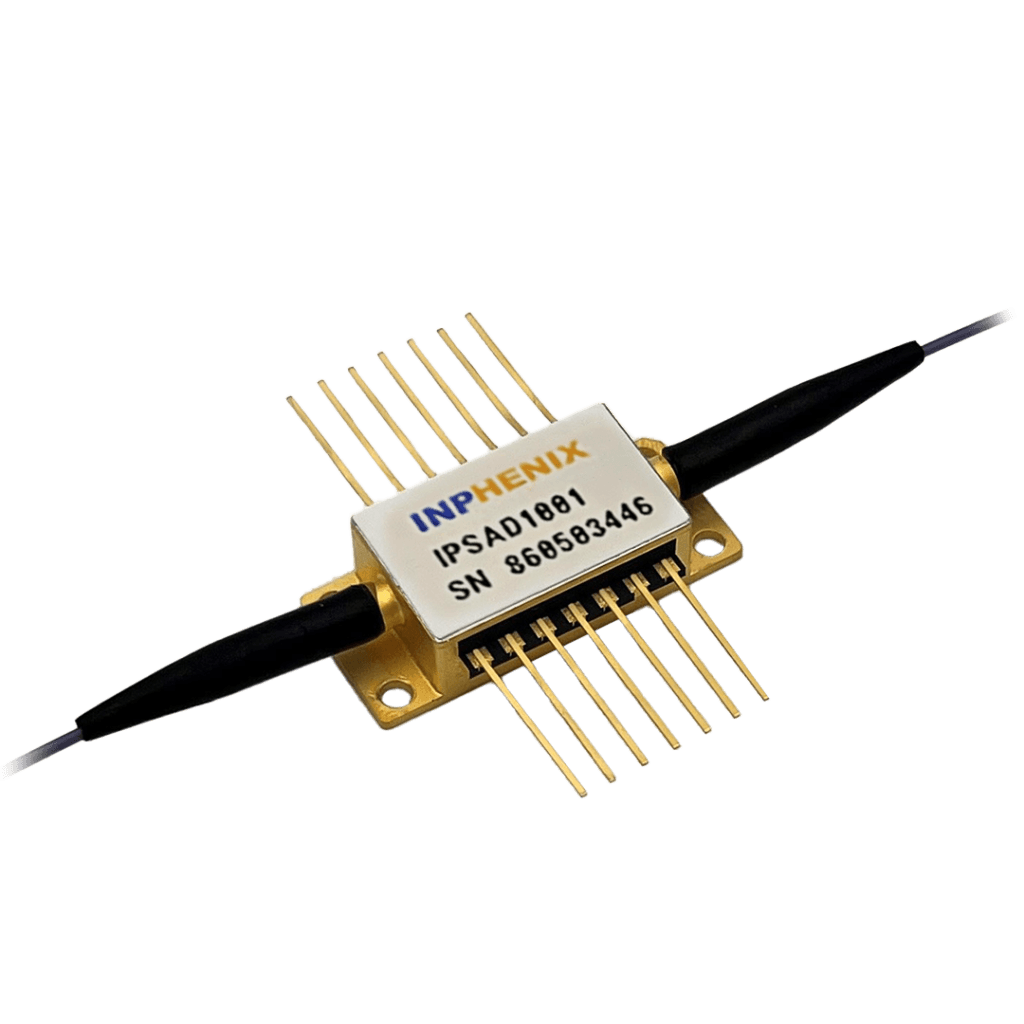
A Semiconductor Optical Amplifier (SOA), crucial for light amplification, stands as a foundational element in contemporary optical networks. This device, essentially a laser diode (LD) designed without feedback from its input and output ports, is also known as a Traveling-Wave Amplifier (TWA). The Semiconductor Optical Amplifier has consistently proven its versatility and multi-functionality, making it an indispensable building block for advanced optical communication infrastructures.
Key Performance Indicators for a Semiconductor Optical Amplifier
Evaluating the efficacy of a Semiconductor Optical Amplifier involves assessing five critical parameters:
- Gain (Gs): Represents the signal’s amplification factor.
- Gain Bandwidth: Defines the spectrum of wavelengths a Semiconductor Optical Amplifier can effectively boost.
- Saturation Output Power (PSAT): The maximum power output attainable before the Semiconductor Optical Amplifier experiences gain compression.
- Noise Figure (NF): Quantifies the noise introduced by the amplifier.
- Polarization Dependent Gain (PDG): Measures how the gain of the Semiconductor Optical Amplifier varies with the polarization state of the incoming light.
The expansive bandwidth and high saturated power capabilities of the Semiconductor Optical Amplifier (SOA) ensure its critical role across a diverse array of optical bands, network architectures, and application scenarios. An optimal Semiconductor Optical Amplifier would ideally offer maximum gain, broad optical bandwidth, exceptionally high saturation output power for superior linearity, a minimal noise figure, and negligible polarization sensitivity. However, the inherent physical limitations of the internal processes mean that a truly ideal Semiconductor Optical Amplifier remains an aspirational benchmark and, with its wide bandwidth and high saturated power, the semiconductor optical amplifier plays a crucial role in various bands, networks, and applications.
Peak Wavelength(nm) To:From: | Category | Typical Gain(dB) From: To | Typcial Psat(dBm) ToFrom: | Typical Spectral Width(nm) To:From: | Max. Noise Figure To(dB) From: | Typical Current(mA) To: | Polarization Dependent or Independent | Package | Part Number |
|---|---|---|---|---|---|---|---|---|---|
| Peak Wavelength(nm) | Category | Typical Gain(dB) | Typcial Psat(dBm) | Typical Spectral Width(nm) | Max. Noise Figure(dB) | Typical Current(mA) | Polarization Dependent or Independent | Package | Part Number |
| 880 | In-Line | 20 | 10 | 40 | 8 | 150 | Dependent | Butterfly | IPSAD0801 |
| 1015 | In-Line | 20 | 11 | 80 | 8 | 250 | Dependent | Butterfly | IPSAD1002 |
| 1040 | In-Line | 25 | 10 | 55 | 8 | 250 | Dependent | Butterfly | IPSAD1003 |
| 1050 | In-Line | 25 | 10 | 45 | 10 | 300 | Dependent | Butterfly | IPSAD1001 |
| 1285 | In-Line | 30 | 17 | 60 | 7.5 | 700 | Dependent | Butterfly | IPSAD1201 |
| 1300 | In-Line | 30 | 15 | 60 | 7 | 700 | Dependent | Butterfly | IPSAD1305 |
| 1300 | In-Line | 19 | 7 | 80 | 7.5 | 300 | Dependent | Butterfly | IPSAD1306 |
| 1310 | Booster | 10 | 11 | 40 | 7.5 | 300 | Independent | Butterfly | IPSAD1307 |
| 1310 | Booster | 22 | 10 | 45 | 7.5 | 250 | Independent | Butterfly | IPSAD1301 |
| 1310 | In-Line | 19 | 7 | 50 | 7.5 | 250 | Independent | Butterfly | IPSAD1303 |
| 1310 | In-Line | 29 | 9 | 40 | 7.5 | 200 | Independent | Butterfly | IPSAD1308 |
| 1310 | Pre-amplifier | 16 | 10 | 55 | 7 | 250 | Independent | Butterfly | IPSAD1304 |
| 1310 | Pre-amplifier | 15 | 7 | 45 | 7.5 | 250 | Independent | 8-Pin | IPSAD1309 |
| 1310 | Switch | 18 | 6 | 40 | 9 | 100 | Dependent | Butterfly | IPRAD1301 |
| 1310 | Switch | 10 | 4 | 50 | 7.5 | 100 | Independent | Butterfly | IPSAD1302 |
| 1490 | Pre-amplifier | 16 | 11 | 55 | 8 | 300 | Independent | Butterfly | IPSAD1402 |
| 1490 | Pre-amplifier | 26 | 9 | 40 | 8 | 400 | Independent | Butterfly | IPSAD1401 |
| 1525 | In-Line | 19 | 7 | 50 | 8 | 300 | Dependent | Butterfly | IPSAD1506 |
| 1550 | Booster | 13 | 14 | 55 | 9 | 500 | Independent | Butterfly | IPSAD1505 |
| 1550 | Booster | 20 | 10 | 45 | 9 | 350 | Independent | Butterfly | IPSAD1501 |
| 1550 | Booster | 15 | 10 | 55 | 9 | 350 | Independent | Butterfly | IPSAD1504 |
| 1550 | Booster | 14 | 16 | 60 | 9 | 700 | Dependent | Butterfly | IPSAD1507 |
| 1550 | Booster | 25 | 12 | 60 | 9 | 500 | Dependent | Butterfly | IPSAD1509 |
| 1550 | Booster | 10 | 12 | 40 | 9 | 300 | Independent | Butterfly | IPSAD1510 |
| 1550 | In-Line | 16 | 5 | 50 | 9 | 350 | Independent | Butterfly | IPSAD1503 |
| 1550 | In-Line | 28 | 8 | 45 | 9 | 350 | Dependent | Butterfly | IPSAD1508 |
| 1550 | Switch | 10 | 3 | 50 | 10 | 120 | Independent | Butterfly | IPSAD1502 |
| 1550 | Switch | 18 | 6 | 40 | 9 | 100 | Independent | Butterfly | IPRAD1501 |
| 1550 | Switch | 22 | 8 | 60 | 9.5 | 600 | Dependent | Butterfly | IPSAD1511 |
| 1550 | Switch | 13 | 12 | 60 | 9.5 | 400 | Independent | Butterfly | IPSAD1512 |
| 1550 | Switch | 22 | 13 | 60 | 9.5 | 600 | Independent | Butterfly | IPSAD1513 |
| 1550 | Switch | 25 | 13 | 40 | 9.5 | 600 | Dependent | Butterfly | IPSAD1514 |
| 1550 | Booster | 20 | 20 | 40 | 8.0 | 1000 | Dependent | Butterfly | IPSAD1515 |
| 1600 | Booster | 20 | 9 | 50 | 10.0 | 400 | Independent | Butterfly | IPSAD1601 |
| 1650 | Booster | 25 | 13 | 40 | 9.5 | 600 | Dependent | Butterfly | IPSAD1602 |
InPhenix: Pioneering Semiconductor Optical Amplifier Solutions
InPhenix is at the forefront of Semiconductor Optical Amplifier technology, delivering advanced solutions that meet the demanding requirements of optical communications. Our 131nm Semiconductor Optical Amplifier is specifically engineered as the premier O-Band Optical Amplifier. Beyond the O-band, InPhenix provides robust Semiconductor Optical Amplifier options for E-band, S-band, C-band, L-band, and U-band wavelengths.
Advantages of InPhenix O-Band Semiconductor Optical Amplifier:
- Saturated power: Exceeds 10dB, ensuring robust signal handling.
- Small signal gain: Greater than 10dB across the entire O-band (127 to 134nm), guaranteeing strong amplification.
- Ripple: Less than 1 dB, indicating excellent signal integrity.
- Compact + Low Cost: Facilitates easy integration and cost-effective deployment.
Typical Applications for O-Band Semiconductor Optical Amplifier:
- 100GBASE-LR4 Transceiver test and measurement: Essential for validating high-speed transceiver performance.
- Passive component testing: Critical for characterization of optical components.
- Splitting/tap loss compensation: Mitigates signal degradation in distributed networks.
- Reach extension (increase link budget): Functions as a booster or pre-amplifier to extend transmission distances.
A Semiconductor Optical Amplifier is an optoelectronic device that can amplify an input optical signal under appropriate operating conditions. A schematic diagram of a basic Semiconductor Optical Amplifier is presented in Fig.1 (below).
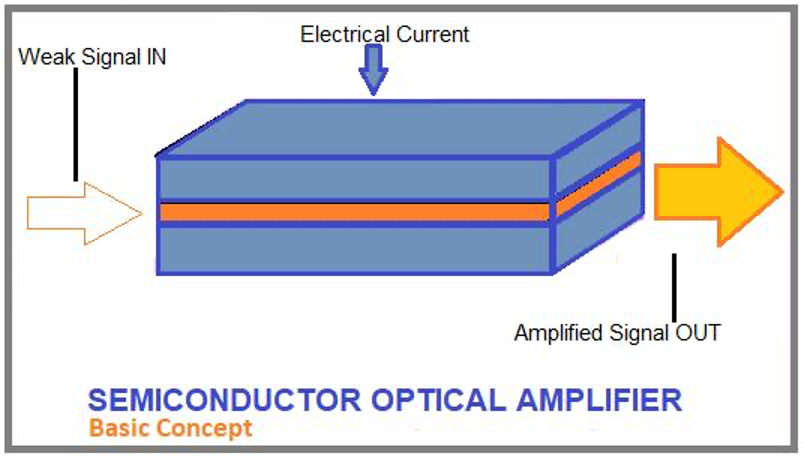
Fig. 2- Semiconductor Optical Amplifier interrelated parameters
The Operational Principle of a Semiconductor Optical Amplifier
A Semiconductor Optical Amplifier (SOA) functions as an optoelectronic device capable of amplifying an incoming optical signal under specific operational conditions. The fundamental operation relies on stimulating photon emission within its active region.
When an external electric current is applied to the Semiconductor Optical Amplifier, it energizes electrons within the active region of a forward-biased pn-junction. As photons traverse this active region, they trigger these excited electrons to release their excess energy, generating additional photons identical in wavelength to the original ones. This process, known as stimulated photon emission, forms the basis of optical amplification. A precisely designed embedded waveguide within the Semiconductor Optical Amplifier confines the propagating signal wave to the active area, ensuring efficient interaction and maximizing the optical gain experienced by the signal.
InPhenix offers its Semiconductor Optical Amplifiers in a variety of form factors, ranging from miniaturized 6-pin mini butterfly packages, ideal for integration into CFP/CFP2 transceivers, to complete desktop units that come integrated with drivers and can be customized with passive components. These diverse offerings ensure that InPhenix Semiconductor Optical Amplifier solutions meet a broad spectrum of application needs, consistently demonstrating impressive parameters in terms of gain, bandwidth, and polarization sensitivity. Our Semiconductor Optical Amplifiers undergo stringent testing to comply with Telcordia GR-468-CORE for unparalleled reliability and adhere to all RoHS directives.
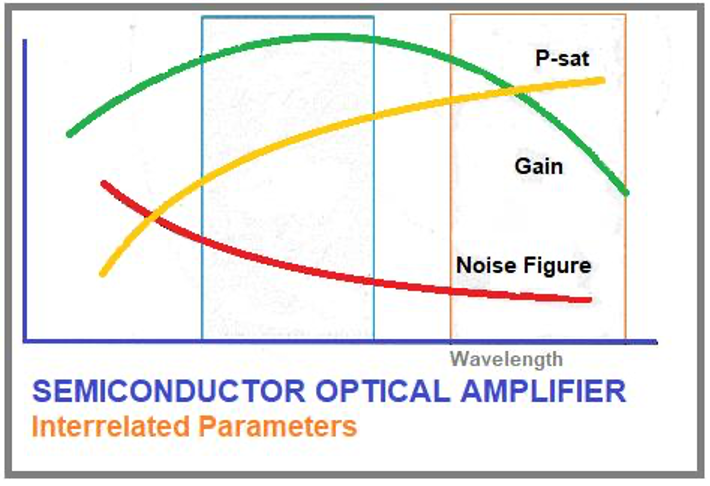
Fig.1- Semiconductor Optical Amplifier simplified diagram
Detailed Amplification Characteristics of InPhenix Semiconductor Optical Amplifier
InPhenix’s Semiconductor Optical Amplifiers are recognized for their versatility and multi-functional capabilities, serving as fundamental elements in optical network architectures. The key parameters that define the performance of our Semiconductor Optical Amplifiers include:
- Small Signal Gain (Gs): Achieves up to 22 dB at -25dBm input power, signifying robust signal amplification.
- Gain Bandwidth: Extends up to 80 nm at 3 dB, enabling amplification across a wide range of wavelengths.
- Saturation Output Power (Psat): Reaches up to 17 dBm, ensuring high power handling before gain compression.
- Noise Figure (NF): Typically ranges from 7.-8. dB, indicating controlled noise addition.
- Polarization Dependent Gain (PDG): Maintained at < 1 dB or up to 10 dB, depending on the specific application requirements for polarization sensitivity.
For optimal performance in a given application, a Semiconductor Optical Amplifier must deliver the highest appropriate gain. A wide optical bandwidth is also highly desirable, allowing the Semiconductor Optical Amplifier to amplify a broad spectrum of signal wavelengths. To mitigate undesirable distortion introduced by gain saturation effects, an ideal Semiconductor Optical Amplifier should possess a very high saturation output power, ensuring excellent linearity and maximizing dynamic range with minimal distortion. Furthermore, an ideal Semiconductor Optical Amplifier should exhibit a very low noise figure (the theoretical physical limit is 3dB) to minimize amplified spontaneous emission (ASE) power at the output. Lastly, a minimal polarization sensitivity is crucial for an ideal Semiconductor Optical Amplifier, ensuring the gain difference between transverse-electric (TE) and transverse-magnetic (TM) polarization states is minimized. However, the intricate interplay of internal physical processes makes the realization of a perfectly ideal Semiconductor Optical Amplifier challenging.
The various parameters of a Semiconductor Optical Amplifier are inherently interrelated, forming a part of the system’s overall SOA design. Achieving peak performance in one specific parameter often necessitates trade-offs in other specifications, or requires precise management of the spectral operating area.
Categorization of Semiconductor Optical Amplifiers
Depending on their intended function within a customer’s system, Semiconductor Optical Amplifiers can be classified into four primary categories:
- In-line Semiconductor Optical Amplifier: Characterized by higher gain, moderate Psat, lower NF, and lower PDG, these are typically polarization-independent for seamless integration.
- Booster Semiconductor Optical Amplifier: Designed for higher Psat and generally lower gain, these are often polarization-dependent.
- Switch Semiconductor Optical Amplifier: Optimized for higher Extinction Ratio and rapid rise/fall times, crucial for optical switching applications.
- Pre-amplifier Semiconductor Optical Amplifier: Ideal for extending transmission distances, featuring lower NF and higher gain for weak signal recovery.
The Polarization Dependent Gain (PDG) is a key determinant of a Semiconductor Optical Amplifier’s polarity. A PDG below 1.5dB indicates a Polar Independent (P-I) Semiconductor Optical Amplifier, whereas a PDG up to 10 dB signifies a Polar Dependent (P-D) Semiconductor Optical Amplifier.
Extensive Applications of Semiconductor Optical Amplifier Technology
Conventional Applications
Amplification stands as a fundamental and pervasive application of Semiconductor Optical Amplifiers within optical communication systems. A Semiconductor Optical Amplifier is an incredibly versatile component, capable of performing a multitude of amplification and routing functions in telecommunications. Commercially available Semiconductor Optical Amplifiers are now widely adopted, providing a cost-effective solution for optical amplification in sophisticated optical systems across core, metro, and ultimately, access network layers. A Semiconductor Optical Amplifier can be deployed in any optical communication network to regenerate signals at various points along the link, providing light amplification and operating effectively as either a booster amplifier (post-amplifier) or an in-line amplifier.
Telecommunications Sector
The telecommunications industry is a major consumer of Semiconductor Optical Amplifiers, valuing them for their capabilities in routing and switching within a service-oriented architecture (SOA). Furthermore, a Semiconductor Optical Amplifier is indispensable for boosting or amplifying signal output in long-distance fiber-optic communications. In this context, telecom companies utilize fiber-optic lines that can span 10km or more between headquarters and data centers, necessitating the use of a Semiconductor Optical Amplifier to amplify the signal originating from standard light sources.
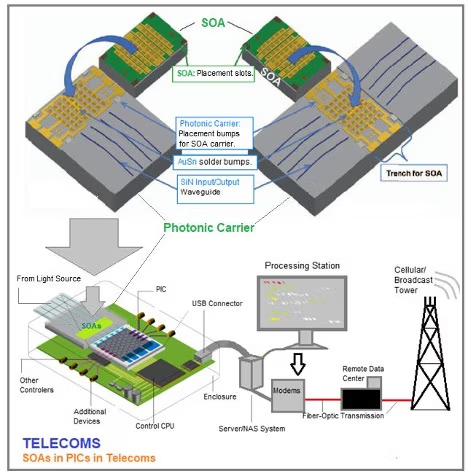
Fig. 3- Semiconductor Optical Amplifier in photonic carriers (top) can be used in Photonic Integrated Circuit (PIC) (bottom-left).
Advanced Functional Applications
Beyond simple amplification, a Semiconductor Optical Amplifier can also execute complex functions that are, and will continue to be, essential in future optically transparent networks. These all-optical functions are crucial for overcoming the “electronic bottleneck,” a significant impediment to the deployment of high-speed optical communication networks, exemplified by applications like optical wavelength converters. Invariably, the functional applications of a Semiconductor Optical Amplifier are predicated on their inherent nonlinearities. These nonlinearities primarily arise from changes in carrier density induced by the amplifier’s input signals. The four main types of nonlinearity commonly exploited in a Semiconductor Optical Amplifier are cross-gain modulation (XGM), cross-phase modulation (XPM), self-phase modulation (SPM), and four-wave mixing (FWM).
Sensing Applications
The sensing industry represents another significant area leveraging Semiconductor Optical Amplifiers in numerous applications. One critical use of a Semiconductor Optical Amplifier in sensor systems is within Fiber-Bragg Interrogators. In this configuration, either an SLD or DFB serves as the input light source. A Semiconductor Optical Amplifier then boosts the optical signal to a fiber-Bragg grating (FBG), frequently via a circulator to manage the direction of optical signals. Changes in temperature or strain induce shifts in the wavelength or timing of these optical signals, which are then detected by a PD/sensor, providing alerts to potential malfunctions.
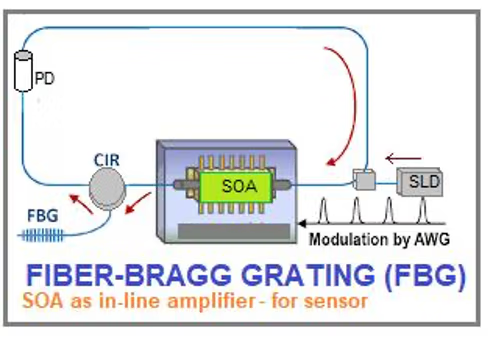
Fig. 4- Fiber-Bragg Grating with Semiconductor Optical Amplifier in-line amplifier
Another vital application of a Semiconductor Optical Amplifier in sensing is with Light Detection and Ranging (LiDAR) systems. LiDAR devices can be compact, designed for Doppler-ranging only, or configured as arrays capable of comprehensive mapping. An example of a LiDAR application utilizes Frequency Modulated Continuous Wave (FMCW) to detect the Doppler effect of motion, which is crucial for autonomous cars and drones. Additionally, FMCW LiDAR is employed for cartography and inspection. A Semiconductor Optical Amplifier used in narrowband systems, typically with DFBs, can achieve high output power (>20mW) for extended range detection.
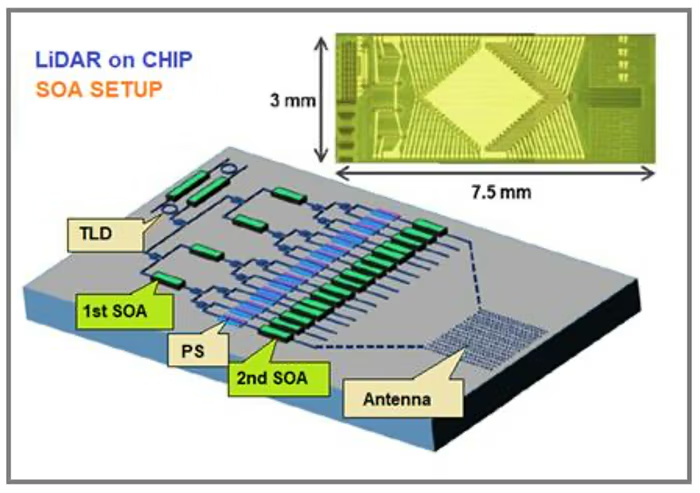
Fig. 5- LiDAR chip with integrated Semiconductor Optical Amplifier. An array of these chips gives a wide-area scan.
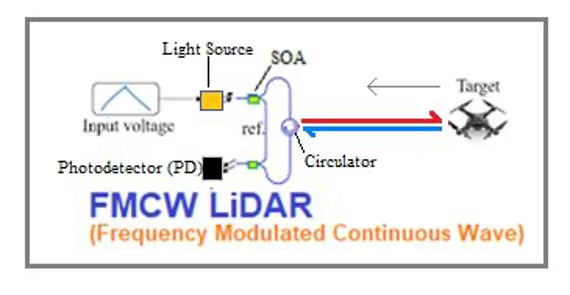
Fig.6- Frequency Modulated Continuous Wave (FMCW) LiDAR. Semiconductor Optical Amplifier in green.
CWDM (Coarse Wavelength Division Multiplexing) Integration
The aforementioned characteristics of small size, excellent integration capability, and the substantial potential for cost reduction through scaled manufacturing processes will continue to solidify the increasingly important role of the Semiconductor Optical Amplifier (SOA) in future advanced optical networks. Coarse Wavelength Division Multiplexing (CWDM) offers an economical pathway to enhanced connection flexibility and increased throughput for metro and enterprise network layers. Expanding the capacity and distance of CWDM systems (beyond 100 km) necessitates a low-cost optical amplifier capable of operating across the entire optical bandwidth (from 126 nm to 162 nm). The Semiconductor Optical Amplifier currently stands as the only viable technology available today that can effectively meet these evolving application demands.
WDM-PON (Wavelength Division Multiplexing-Passive Optical Networks) Deployment
An expanding role for the Semiconductor Optical Amplifier (SOA) in telecommunications lies in their deployment within Wavelength Division Multiplexing-Passive Optical Networks (WDM-PON). Cable companies that utilize fiber-optic lines extending from their central offices to customer premises often employ nodes, or distribution centers, to facilitate data switching and routing. This architecture enables the efficient distribution of data to a large subscriber base. While a Semiconductor Optical Amplifier represents an early application within WDM-PON, its use is anticipated to grow significantly in the future.
Beyond these, several other compelling applications for the Semiconductor Optical Amplifier exist. These include intensity and phase modulation, Semiconductor Optical Amplifier logic for optical signal processing, Semiconductor Optical Amplifier add/drop multiplexers for optical time division multiplexed networks, Semiconductor Optical Amplifier pulse generators for easy generation of high-frequency pulses (> 10 GHz), Semiconductor Optical Amplifier clock recovery essential in optical receivers and 3R generators, Semiconductor Optical Amplifier dispersion compensators to counteract chromatic dispersion which limits transmission distance, and Semiconductor Optical Amplifier detectors for optical signal detection. Furthermore, a Semiconductor Optical Amplifier can be utilized for gating optical signals, meaning signals can be either amplified or absorbed. The blocking properties of a Semiconductor Optical Amplifier at low bias currents are exceptionally valuable, enabling channel routing functions, such as reconfigurable add/drop multiplexers (ROADM), to be realized with off-channel isolation exceeding 50dB.
Advantages of Employing a Semiconductor Optical Amplifier
The Semiconductor Optical Amplifier offers several compelling advantages for optical network designers and operators:
- Wavelength Independence: The optical gain provided by a Semiconductor Optical Amplifier within its bandwidth is relatively independent of the wavelength of the incident optical signal, offering operational flexibility.
- Electrical Pumping: The injection of electric current serves as the pump signal for light amplification, eliminating the need for complex and often bulky optical pumping schemes.
- Compact Integration: Due to their small footprint, Semiconductor Optical Amplifiers can be readily integrated with various waveguide photonic devices on a single planar substrate, leading to more compact and efficient systems.
- Established Technology: They leverage the same mature manufacturing technology as diode lasers, ensuring reliability and cost-effectiveness.
- Broad Band Operation: Semiconductor Optical Amplifiers possess the ability to operate across crucial communication spectral bands of 130 nm and 155 nm, often with wide bandwidths (up to 100 nm).
- Receiver Pre-amplification: They can be configured and integrated to function effectively as pre-amplifiers at the optical receiver end, boosting weak signals.
- Logic Gate Functionality: A Semiconductor Optical Amplifier can serve as simple logic gates in WDM optical networks, enabling advanced signal processing.
Limitations of Semiconductor Optical Amplifier Technology
Despite their numerous advantages, Semiconductor Optical Amplifiers do present certain limitations:
- Output Power Constraints: A Semiconductor Optical Amplifier can typically deliver output optical power only up to a few tens of milliwatts (mW). While often sufficient for single-channel operation in a fiber-optic communication link, a WDM system may necessitate several mWs of power per channel, potentially requiring multiple SOAs or alternative amplification.
- Coupling Loss Mitigation: The inherent coupling of the input optical fiber into and out of the Semiconductor Optical Amplifier integrated chip tends to induce signal loss. Consequently, the Semiconductor Optical Amplifier must provide additional optical gain to compensate for this loss at the input/output facets of its active region.
- Polarization Sensitivity: Semiconductor Optical Amplifiers are typically highly sensitive to the polarization of the input optical signal, which can be a design challenge in some applications.
- Noise Generation: They generally generate higher noise levels in the active medium compared to optical fiber amplifiers, impacting signal-to-noise ratio.
- Crosstalk in WDM Systems: In applications where multiple optical channels are amplified, as commonly required in WDM scenarios, a Semiconductor Optical Amplifier can produce severe crosstalk, which must be carefully managed.
Unlock the Future of Optical Communications Technology with InPhenix Semiconductor Optical Amplifier
Contact our experts today to discuss your specific requirements and discover how our reliable, high-quality Semiconductor Optical Amplifier products can elevate your optical system capabilities. Don’t compromise on optical performance. Choose InPhenix Semiconductor Optical Amplifiers for superior gain, bandwidth, and reliability.